

 This year, my travels took me to France, a place with a mouth-watering smell of freshly baked croissant, a sophisticated and artistic allure present on every street and building, and a mixture of urban and provincial people. With my bags packed and my anticipation sky high, I climbed into the airplane and wondered how this trip would turn out.
There were no direct flights to Paris from LAX so we had to take a transfer flight at not only America’s busiest, but also the world’s busiest airport. Surprisingly, this airport wasn’t JFK airport in New York, but Hartsfield-Jackson airport in Atlanta. It is the world’s busiest airport by passenger traffic, serving 88 million passengers per year, as well as by number of landings and take-offs. The 1996 Olympic Games held in Atlanta propelled this once miniscule airport to the world’s busiest airport. Fortunately, the transfer wait was very short and we were quickly off for Paris.
The flight time from Atlanta to Paris is nothing compared to flights to Asia. The fast tail wind brought our flight time down to 9 hours so before we knew it, we landed in Paris at sunrise. After a quick luggage pickup and a fast check of our passports, things were looking up and the trip seemed to be going smoothly. Nevertheless, there always has to be a problem and our group got stuck in a stubborn automatic revolving door. It seemed that the door wanted to inch at a snail-like pace. Because our group was so large  and there was only one door out, we all crowded in and the doors would stop every time someone bumped into it or the walls. It was as if we were going through an upside-down funnel.
After a good quarter of an hour wrestling with the recalcitrant door, we found our bus and were on our way to Paris, the City of Lights. The newly sprung spring green welcomed us with a bright green hue that enveloped the fields on the sides of the motorway. As we entered the city, the fields of green drew back and were replaced with quaint beige buildings all styled with the same artistic touch. The strict construction code in Paris guaranteed that the city would look uniform and antique. Citizens are not allowed to repaint their homes and buildings with bold colors. To the Paris officials, the only color that existed was beige. Of course, new buildings in the urban side of Paris (the North Side) were free to do whatever they pleased. In addition, we quickly noticed that Paris’ unique organizational system. In America, large metropolitan cities usually have a main street with numbered streets following afterward. In Paris, they have areas in addition to street names. Paris has a total of twenty areas that radiate from the center of Paris, the Louvre. As the area number becomes larger, the distance from the town’s center is greater.
 Before we visited area 1, the Louvre, we made a stop in area 18, the site of Moulin Rouge. We wouldn’t see the show until the night after, but we got a chance to take some pictures. Afterwards, we walked uphill to the nearby Sacre Cour Basilica or Sacred Heart Basilica on Montmartre Hill as we brazed the thundering rain. The wind blew away the feeling from our hands and left us numb to the bone. Paris is known to have on and off showers. Usually, the rain would start in the morning and die off in the afternoon providing an optimal and clean atmosphere. As we entered the cathedral, we admired the intricate interior design and its warmth. The area in front of the cathedral also provided us with a magnificent bird’s eye view of Paris, which made my first morning in Paris unforgettable.
Our next stop was the Louvre Museum in area 1. The Louvre was initially the palace of the French Kings starting with Phillip II in the late 12th Century to Louis XIV in 1672. On August 10, 1793, the Louvre became a museum to celebrate the end of the French monarch. Gradually, the purpose of the museum changed to connect different artistic cultures from around the world and it is now the world’s busiest museum. In front of the museum’s entrance is a glass pyramid pointed to down, while there is an upright glass pyramid after the entrance. Both structures were designed by the famous Chinese-American architect, I.M. Pei.
The art pieces featured in the Louvre are perhaps the world’s most varied art collection, which has also brought the museum much controversy. As the French traveled around the Western world they collected numerous pieces of art. Thus, many of the art pieces do not belong to the French, but the French are not entitled to return them because they consider the Louvre as an international museum. Fortunately for us, this means we were given the opportunity to see many of the world’s most renowned masterpieces all in one roof.
 The sphinx, a lion with a human head, from Egypt sits in the middle of the Egyptian exhibit as the Venus de Milo from Greece stands in front a mass of tourists and local visitors in addition to the hundreds of other paintings and statues. Some paintings like the Coronation of Napolean painted by Jacques-Louis David take up an entire wall and have dimensions that range from 200 to around 400 inches. Nevertheless, the true crowd bringer is undoubtedly Leonardo de Vinci’s Mona Lisa, the only uninsurable art piece in the world. The madhouse that surrounded the Mona Lisa made it seem like an impossible task to get a picture, but we slowly pushed through and got as close to the painting as possible. We gazed at the Mona Lisa’s mysterious smile and were mesmerized by its magnetic eyes that seemed to follow us every step of the way. However it didn’t follow us towards the exit as we concluded the end of our tour to the Louvre.
Our next stop was Lafayette Gallery, one of the world’s most premier shopping plazas. Joe, our tour guide and our previous tour guide for Yellowstone and Italy, told us that if you can’t find what you’re looking for here, it doesn’t exist. The gallery had every brand imaginable including Hermes, Louis Vuitton, and Montblanc, all French brands. Before that, however, we had to drive by what is now known as the 13th pillar tunnel, the location of Princess Diana’s car accident and death. As Princess Diana left the Ritz Carlton in Place Vendome —which he also drove by-, she was greeted by her driver who was allegedly drunk. Not long after, Princess Diana’s car crashed into the 13th pillar at a nearby tunnel. A statue of a blazing fire located on top of the tunnel was put in place to pay homage to her death.
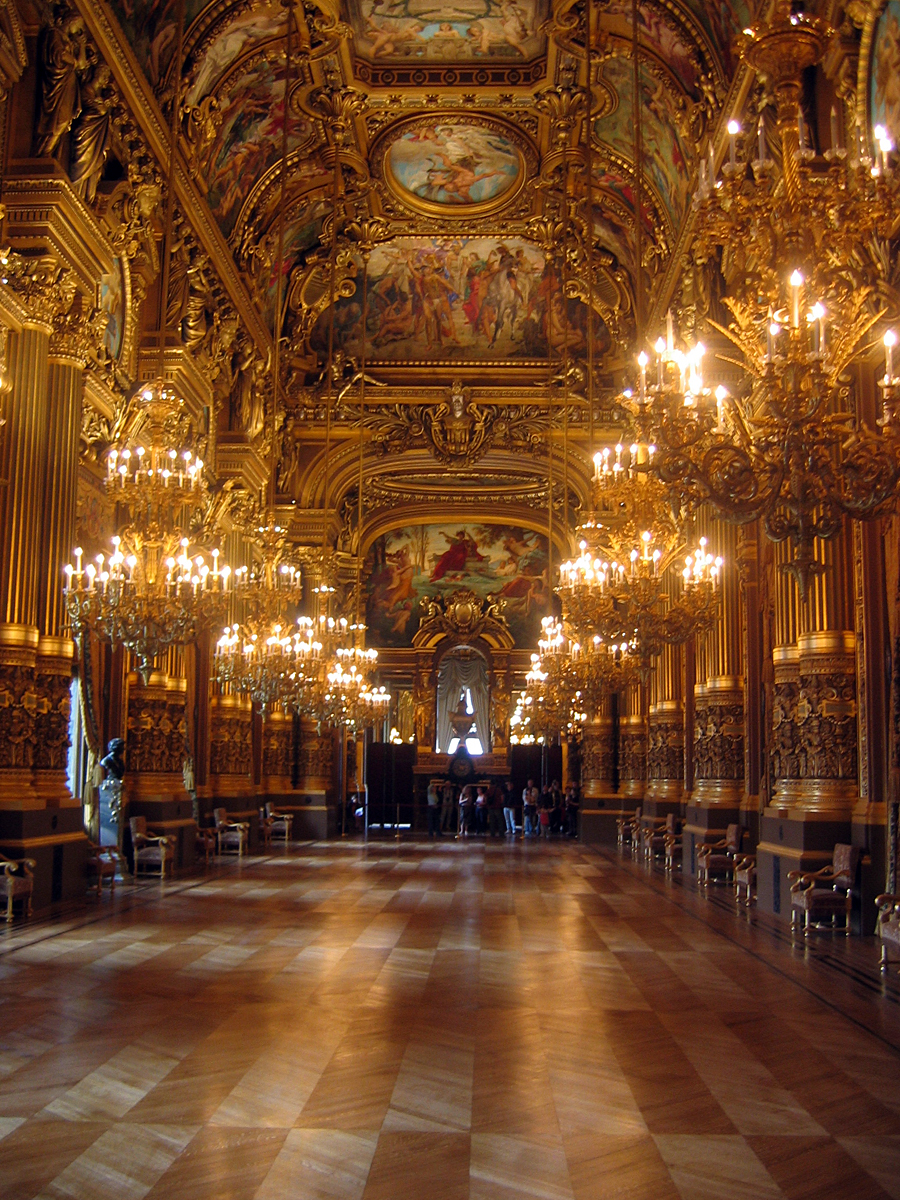
 Surprisingly, Paris is actually very small and compact —well the interesting part at least-. So we ended up driving by many of the sites that we would visit later on such as the Place de la Concorde, Eiffel Tower, Triumphant Arch, Museum of Orangerie, and much more. Paris is simply filled with too many attractions and historical pieces that you’re bound to see something famous with a few minutes of driving. Finally, we pulled up to our real location, the Lafayette Gallery named for the famous French general that helped America win the Revolutionary War in the late 1700s, but another famous tour attraction —Palais Garnier (Paris’ Old Opera House)- was located right next to the shopping strip so we stopped by there first and took some pictures. This Opera House inspired the play Phantom of the Opera when a counterweight to a grand chandelier failed and killed one person in the 1800s. The exterior of the Opera House was lined with towering columns and gold statues. In Paris, it’s very common to see gold painted on some of the artistic elements of buildings or even completely gold statues. However, the luster and hue of the gold paint in Paris is shinier than ordinary gold leaf. It seems as if real gold was actually melted down and painted all over the entire city. Unfortunately, people are not allowed to enter unless there is an event, but the interior of the building is also extravagant and very golden.
Finally, our group was allowed to have our way with the shopping plaza and we charged like a pack of voraciously hungry dogs. Composed of 3 buildings, an endless variety of clothes, and a new take on the phrase, ‘shop till you drop, “ the Lafayette Gallery can be seen as a department store on steroids. The vast array of clothing and products is enough to make even the best shoppers unsure of what to buy. As expected, the rain began to fade away and we had the rest of the day to shop in the Gallery and the mile long shopping street next to it. As the beautiful orange sky turned to black, the streets of Paris lit up and introduced a lively side of Paris. We drove around the Paris night life to our Novotel Hotel.
Bonswa
Related Posts